Something new,
every day.
A small, complete thing built each day: a tool, a toy, a simulation, an experiment. Everything runs in your browser. Nothing is uploaded, and there are no accounts.
Latest

It Turns a Little, Every Click
A click pen's button doesn't push the tip in and out directly. It turns a toothed cam by half a tooth each press — which is exactly why every other click locks.
OpenSeries
Earlier

The Screen Sees Two, Guesses Four
A touchscreen's wires are spaced wider than a fingertip, so every touch blurs across several at once. Touch it with two fingers and watch a simple grid lose track of which crossing is real.
Open
The Angle Every Drop Agrees On
Millions of raindrops each bend sunlight by a different amount depending on where it enters them — but the bent rays all pile up brightest at one exact angle, 42°. Trace the ray yourself and find it.
Open
No Grain Knows It's Building a Dune
Two rules — hop downwind, tumble downhill past a critical slope — and a flat field of sand organises itself into ripples, then crescent dunes, with nobody drawing them.
Open
Compounded, Not Added
A grocery list with the year stripped off. Guess the decade from five rounded prices, then watch the same few percent of inflation, landing every year, turn a dollar into loose change.
Open
Six Dots Are Enough
Three rows of two dots, each raised or flat, gives sixty-four combinations — enough for every letter, digit and mark in English. Type a sentence and watch it turn into Braille, or build a cell yourself and see what it spells.
Open
The Marble That Grabs the Belt
A seatbelt locks two separate ways: yank the webbing fast enough to swing a flyweight, or brake hard enough to tip a ball sitting loose in a cup.
Open
Always Rising, Never Higher
Eight overlapping tones glide upward together, each one fading out exactly as another fades in an octave below. Drag the column yourself and hear why a scale can climb forever.
Open
The Branch That Gets Ahead
A swarm of random walkers drifting toward one point draws the same fractal branches as a real lightning bolt or a burn mark in wood — because both obey the same equation. Strike anywhere and reshape it.
Open
Your Hand Shakes, the Curve Doesn't
A mouse stroke is hundreds of jittery points. Draw one and watch an algorithm throw out most of them, then watch a second one fit a smooth Bezier curve through what's left, ready to export as SVG.
Open
The Jam Nobody Caused
A ring road with no bottleneck, no light and no accident, just cars trying to keep a safe gap. Watch a jam appear anyway, then speed up driver reaction time until it vanishes.
Open
The Window That Moves
Pick places around the world and their whole day lines up as a ribbon on one shared UTC axis, so the one stretch of hours everybody is awake together jumps right out — and shifts when daylight saving does.
Open
The Pattern Nobody Drew
Two chemicals diffuse at different speeds and react where they meet — spots, stripes, mazes and coral fall out with no blueprint. Paint a seed of one chemical and watch the rule decide what grows.
Open
A Red That Fails, a Grey That Passes
Pure red on white text fails WCAG's contrast check; a plain grey, #767676, passes it — contrast depends only on luminance, not hue. Drag a dial to explore every hue, then run the test on a real photo.
Open
Falling Fast Enough to Miss
An orbit is just falling, sideways, fast enough to keep missing the ground. Drag to launch a probe past a star, a moving planet or a binary pair, and read off its real orbital mechanics.
Open
The Kaleidoscope Without Glass
A kaleidoscope's pattern comes from a strict rule, not magic glass: rotate and reflect around a centre. Draw one stroke and watch it multiply into a mandala, then slide the fold count and watch the same strokes become a different flower.
Open
The Long Way to English
Sugar came through Sanskrit, Persian, Arabic and Italian before it reached English. Pick a word and follow the route it actually took, then check seven word-origin stories that are flat-out false.
Open
Bubble Sort Never Wins
Four sorting algorithms start from the same shuffled list and race to put it in order, every comparison and swap playing a note. Two finish almost at once; two are still grinding through it.
Open
Shorter Paths Smell Stronger
Ants lay a fading trail of scent on every walk home. A short path gets walked more often per minute, so its scent never finishes fading — and the whole colony ends up on it without a single ant choosing on purpose.
Open
Closest Seed Wins
Every pixel joins whichever seed point is nearest to it. Scatter the seeds, drag one, or relax them toward evenness, and watch a photo turn into stained glass.
Open
Fifty Minutes Later
The Moon rises about fifty minutes later each day than the day before, a drift that skips a calendar day once a month. Plan a month of moonrises for any place on Earth.
Open
The Words Hiding in Your Name
Type a name or word and watch every English word that fits inside its letters — each one used no more than it appears — climb out of the pile.
Open
Every Row Is a Pitch
A spectrogram turns time into left-to-right and pitch into up-and-down. Draw on one, load a photo, and hear exactly what you drew.
Open
The Pattern That Never Repeats
A kite and a dart, split in half and refit by one fixed rule, grow a tiling that can never repeat — and whose two shapes arrive in the golden ratio, closer with every generation.
Open
The Trailing Edge Decides
A wing doesn't lift because split air reunites behind it — that's a myth. A sharp trailing edge forces smooth flow off the back, and that one condition fixes the circulation, the lift, and where a real wing stalls.
Open
Build a Wave to Kill a Wave
Noise-cancelling headphones don't block sound — they play an inverted copy of it. Delay that copy and watch cancellation turn into amplification.
Open
The Angle Drag Steals
In a vacuum, 45° always sends a projectile the farthest. Launch a shot put, a baseball, a shuttlecock or a beach ball and watch air resistance pull that angle down.
Open
The Gear You Never Use
Shift a bicycle's two chainrings against its eleven-sprocket cassette and watch the chain line itself reveal the two combinations that cross it badly.
Open
Enough Left to Read
A QR code hides spare Reed-Solomon codewords behind its pixels. Smudge it by hand or at random and watch exactly how much damage it survives.
Open
It Never Leaves Twice as Fast
Lift two balls on a Newton's cradle and momentum alone would be happy to send one ball out at double speed. Watch why that never happens, collision by collision.
Open
The Shape Your Sentences Make
Two numbers predict how hard a piece of writing feels: how long its sentences run, and how many syllables its words carry. Watch them become a skyline.
Open
The Angle Light Won't Cross
Light bends crossing into any other transparent medium, by Snell's law — except leaving a denser one steeply enough, where it can't cross at all. Find that exact angle in water, glass and diamond.
Open
The Slider Holds Nothing Shut
A zip's slider doesn't grip the fabric — a wedge inside it cams two rows of identical hooks into alignment, and the hooks' own shape does the locking. Bend one hook and watch the slider jam on it.
Open
The Same Lie, Three Times
A GPS receiver's clock is cheap and wrong by an unknown amount, and every satellite range it measures inherits that same error. Drag one slider to cancel it and watch three near-misses collapse onto your exact position.
Open
Every Peg Is a Coin Flip
A ball falling through rows of pegs turns left or right by pure chance at each one. Drop a thousand and watch the bell curve fall out of the bouncing.
Open
Clap, Clap, Wave, Clap
A tabla cycle claps three of its four sections and waves the fourth in silence, so the room always knows where beat one lands. Type the bols and play it.
Open
The Water It Displaces
A solid steel bar sinks; the same steel, hammered into a hollow hull, floats. Flatten a block into a hull and watch exactly how much water it has to push aside before it can rest.
Open
The Pixel Is Three Lights
Every colour a screen shows is really red, green and blue lights glowing at their own brightness, blended by your eye into one. Drag a magnifying lens over a scene, or mix a colour yourself, and watch the three lights pull apart.
Open
The Knot You Never See
A sewing machine's lockstitch locks two threads together inside the fabric, not on either surface — a rotating hook lassos the needle thread's loop all the way around the bobbin before the take-up lever snaps it tight. Scrub through one stitch, frame by frame, to see the catch happen.
Open
What the Eye Never Missed
A photo is secretly 64 fixed wave patterns repeated over every 8×8 block. Drag the quality slider and watch JPEG throw away the ones your eye wouldn't miss.
Open
Why the Sky Is Blue
Air scatters short wavelengths of light far more than long ones. Drag the sun down toward the horizon and watch blue get stripped out of its light first, leaving the sun red.
Open
Why It Doesn't Stop Halfway
A siphon runs on nothing but a height difference and a tube with no air in it — not suction. Raise the outlet to slow it, or let one bubble into the crest to stop it outright.
Open
Push With It, Not Against It
A swing pumped exactly on its own beat swings far higher than one pumped harder but off time. Drag the push-rate slider and trace out the resonance curve yourself.
Open
The Wheel That Runs Backward
A spinning wheel filmed at a fixed frame rate can look frozen, crawling, or spinning the wrong way. Set the true speed and the sample rate yourself and watch the exact moment it flips.
Open
Power Finds the Weakest Wheel
A car's differential splits engine torque evenly between its two wheels, which is exactly why they can spin at different speeds round a corner — and exactly why one wheel on ice can strand the other, no matter how much grip it has.
Open
As Far As You Like
Stack flat blocks past the edge of a table, one at a time, and find out how far the top one can reach before the tower falls. The exact record for n blocks is half the harmonic series — a sum that never stops growing, just agonisingly slowly.
Open
The Rarest Two, Every Time
Type anything and watch Huffman's 1952 trick build its own code: merge the two rarest symbols, every round, until the commonest letters end up with the shortest bits.
Open
One Tooth at a Time
A falling weight wants to spin a gear as fast as gravity allows. The escapement lets through exactly one tooth per half-swing of a pendulum — starve it or overdrive it and watch why neither works.
Open
A Secret Nobody Sent
Two people who have never met agree on a secret key while a stranger hears every word between them. Mix it in paint, then do it properly with a prime — and set the eavesdropper loose to try every key there is.
Open
Why the Siren Drops
A siren holds one note the whole way past; what changes is the spacing of the crests it leaves in the air, crowded ahead and stretched behind. Send it by at anything from bicycle pace to Mach 1.3, and hear why the true pitch reaches you only after it has gone.
Open
Only One Plane Is Sharp
A lens brings exactly one distance to a point; everything nearer or farther lands on the sensor as a disc, and the width of that disc is the blur. Open the aperture and watch the sharp slice close to seven centimetres, while the far lamps swell into hexagons the shape of the hole.
Open
The Error Names Itself
Sixteen bits go down a wire, one arrives wrong, and there is nobody to ask for a resend. Flip any bit and four parity checks spell out its address in binary; flip two and watch the code notice that it can no longer be sure.
Open
Five Pins and a Line
The lock on your front door is five stacks of two pins, and the only thing a key does is lift every join to one line. Cut a key until it turns, or pick the lock the way it is really done — one binding pin at a time, by feel.
Open
Sand Finds the Silence
Sand on a bowed metal plate is thrown off everything that is moving and comes to rest on the lines that are not, so it draws the shape of the note. Hunt for one of the plate's own pitches, move the bow to choose between figures that share it, and watch thirteen thousand grains walk into place.
Open
Never a Fifth Colour
Four colours are enough to paint any map so that no two countries sharing a border match. Colour an invented one yourself, try it with three and watch that fail, or set the search going and see it place, clash and backtrack its way to an answer.
Open
The Weight of Syllables
Sanskrit verse is measured by weight, not by stress or rhyme: every syllable is light or heavy, and a metre is one fixed sequence of the two. Paste a verse in Devanagari or roman to see it scanned syllable by syllable, the mātrās counted, and the metre named out of twenty-three.
Open
Pulled Both Ways
The Moon raises a bulge of ocean on the side facing it and an equal one on the far side, which is why a harbour gets two high tides a day. Drag the Moon round its orbit, subtract the pull the whole Earth feels, and watch what is left over push the water out at both ends.
Open
A Clock of Ragas
Hindustani music gives every raga an hour of the day. Drag the hand around a 24-hour dial to hear the hours change: fourteen ragas, a tanpura tuned to your Sa, and a keyboard that only has the notes each one allows.
Open
Knots at the Doorstep
A sikku kolam is one line of rice flour looping around a grid of dots, with no loose ends. Twist any crossing and two lines fuse or one splits — the traditional goal is to get the whole pattern down to a single closed loop.
Open
The Shape of a Secret
One message, three machines: Caesar, Vigenère, Enigma — with a live count of its letters underneath. Watch the fingerprint of English flatten into noise, then break the first two ciphers from the frequencies alone.
Open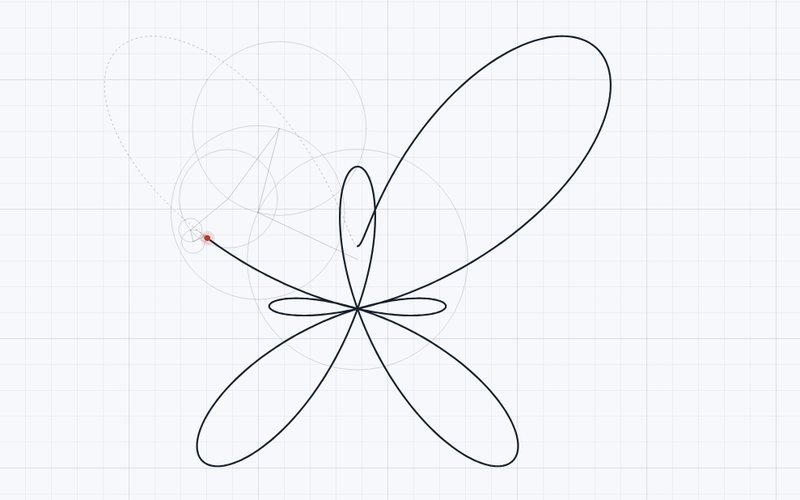
Drawn by Circles
Every closed line is a sum of circles turning on circles. Draw one and watch a chain of them redraw it — then take circles away and see how few it really needs.
Open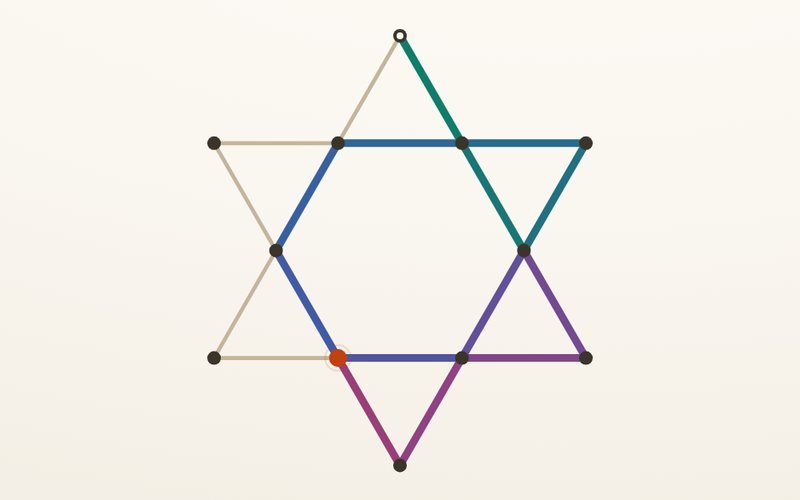
Without Lifting the Pen
Trace every line of a figure in one unbroken stroke, no line twice. Euler settled which figures can be done in 1736, and the ringed corners give the rule away.
Open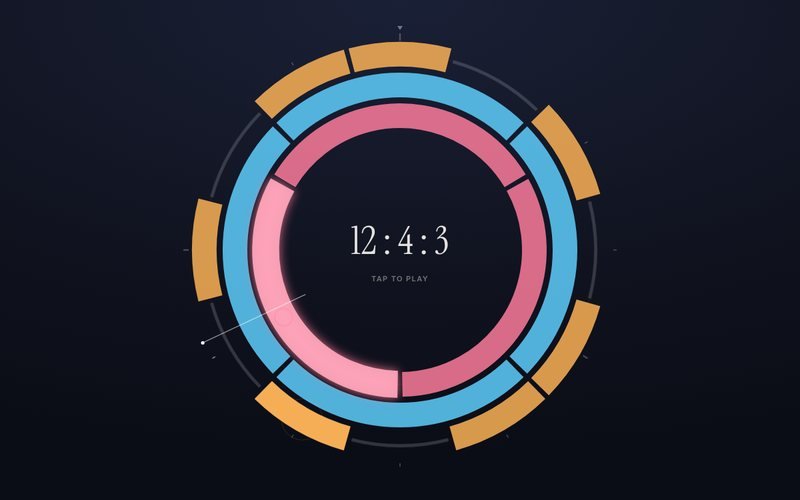
Wheels Within Wheels
Three beats in the time of four. Concentric rings divide one revolution different ways, so you can hear a polyrhythm and watch where the beats land together.
Open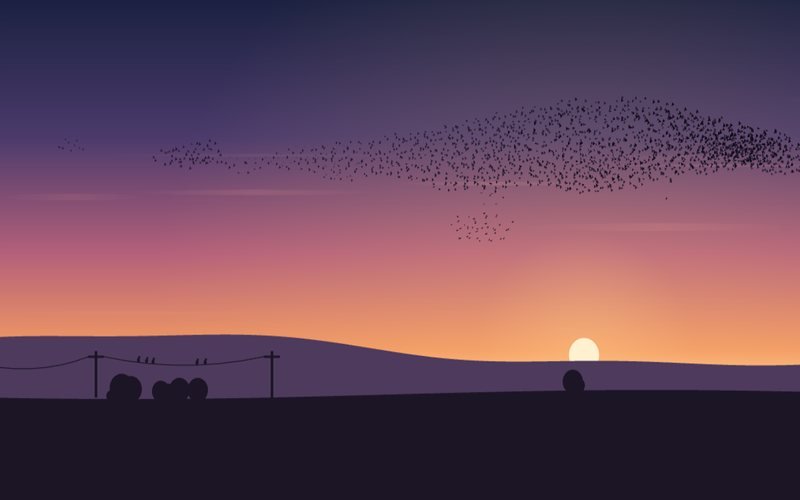
Murmuration
Two thousand starlings, each watching only its seven nearest neighbours. Fly through them as a falcon and watch the panic ripple.
Open
Saramsha
Paste any text and see which sentences carry its meaning. A TextRank summarizer that runs entirely in your browser.
Open